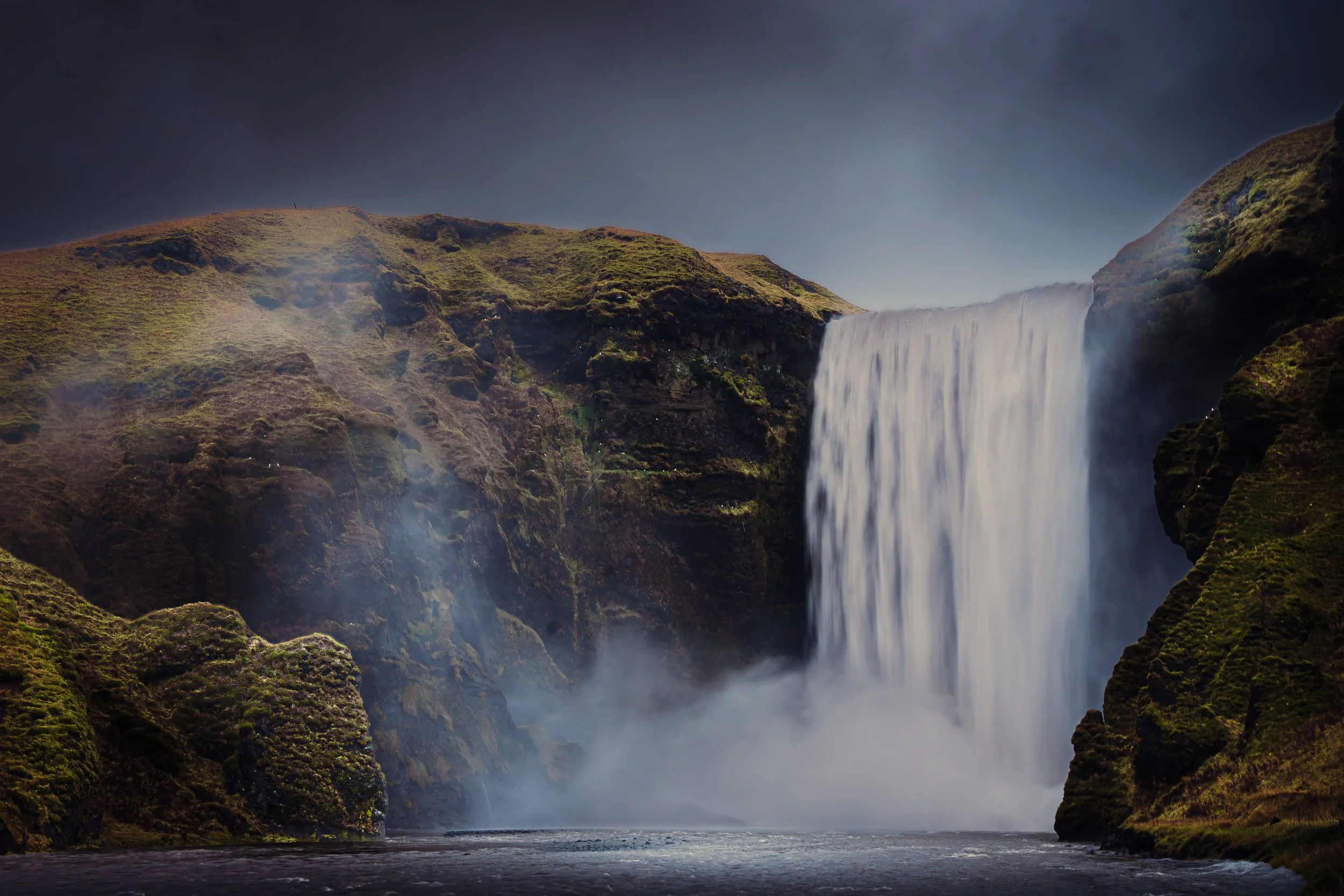
Skógafoss on my first morning in Iceland, with mist spreading across the cliffs and river.
In the original capture, Skógafoss looks brighter than I remember it feeling. The sky is pale, the hills lean toward brown, and the water has much the same grayness as the river below it. There is plenty in the frame to tell me where I was. The atmosphere takes more work.
What I remember is cold rain, fingers starting to tingle, and a waterfall that had pulled my attention away from an entire landscape of hills and cliffs. Bringing that experience into the finished photograph became part of the work after I left.
I had landed in Iceland at 5:30 in the morning without having slept. Two hours of the drive toward Vík had been in darkness. Skógafoss was my first photography stop of the trip, and its appearance beside the Ring Road caught me by surprise.
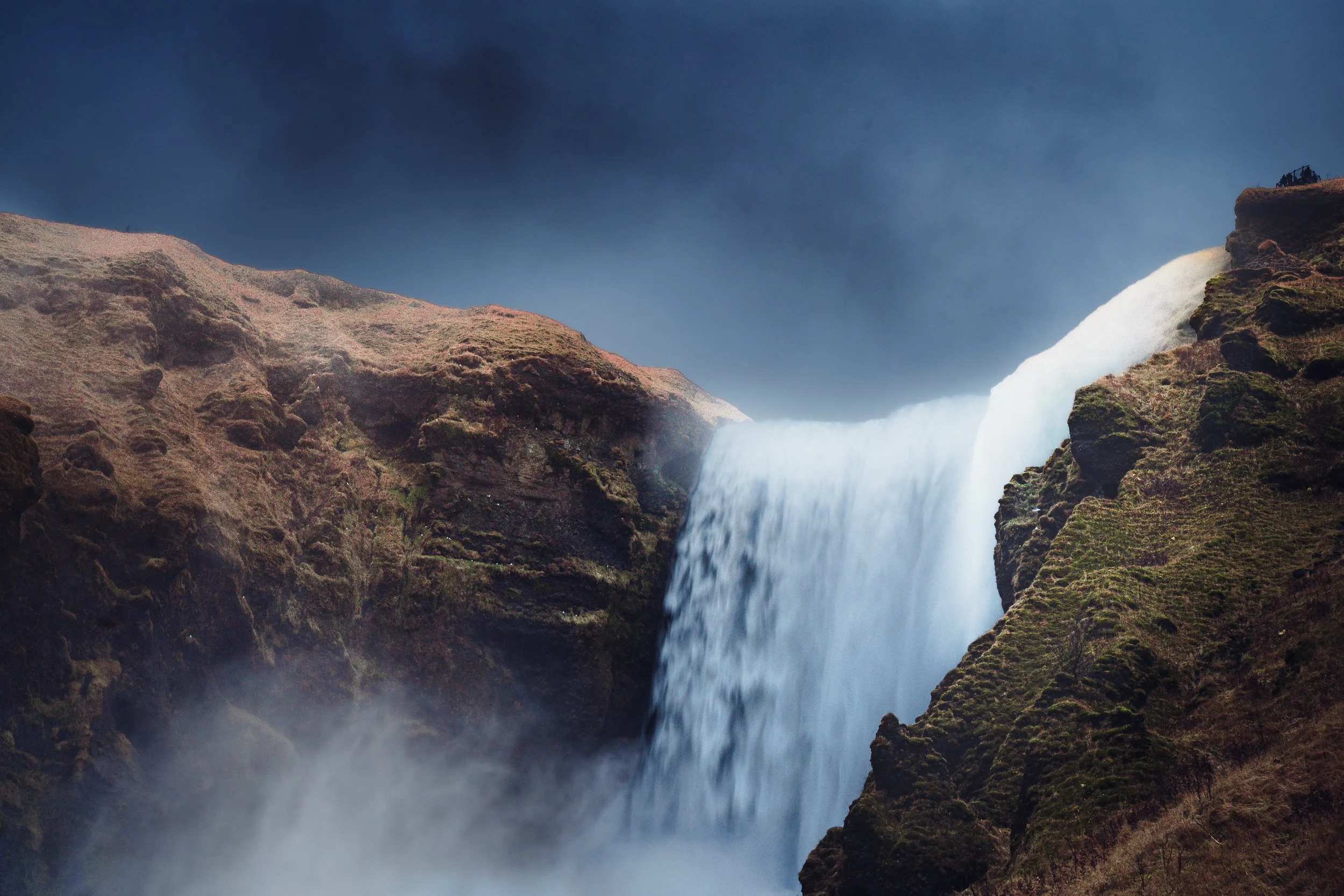
Working farther from the base and framing tightly limited the compositions I could make, while bringing more attention to the water and rock.
At home in the Pacific Northwest, I’m used to waterfalls that require some effort to reach. There might be a short walk or a longer hike before the landscape reveals what you came to see. Skógafoss was already there beside the road, wide and imposing, drawing my eyes toward it. Even then, it occupied only a small part of the hills and cliffs around it.
That first view was almost more impressive than walking up to the waterfall. From the road, I could take in its place in the landscape. On foot, I became occupied with trying to photograph it.
I had brought clothing for the cold and rain. Much of it was still in my luggage, where it was doing an excellent job of staying dry. By the end of the visit I was drenched, with numb, tingling fingers and a much stronger interest in the whereabouts of my gloves.
The crowds were the harder problem for the photographs. I had compositions in mind that I couldn’t make work with so many people near the base. I moved farther away and framed more tightly. That gave me room to concentrate on the falling water and the cliffs, but it also narrowed what I could include.
The waterfall remained impressive throughout. My frustration was with the distance between the photograph I had imagined and the one I could make from the space available.
Then there was the light. A heavy gray sky and showers of cold rain gave the whole scene a subdued appearance. I could feel the mood of the place while standing there, but I was struggling to bring it into the capture.
I wanted to record the movement of the water. Working around the crowds and within the space I had, I ended up with a brighter exposure to get the shutter speed I wanted. It was a compromise made during that session, and it left more work for the edit.
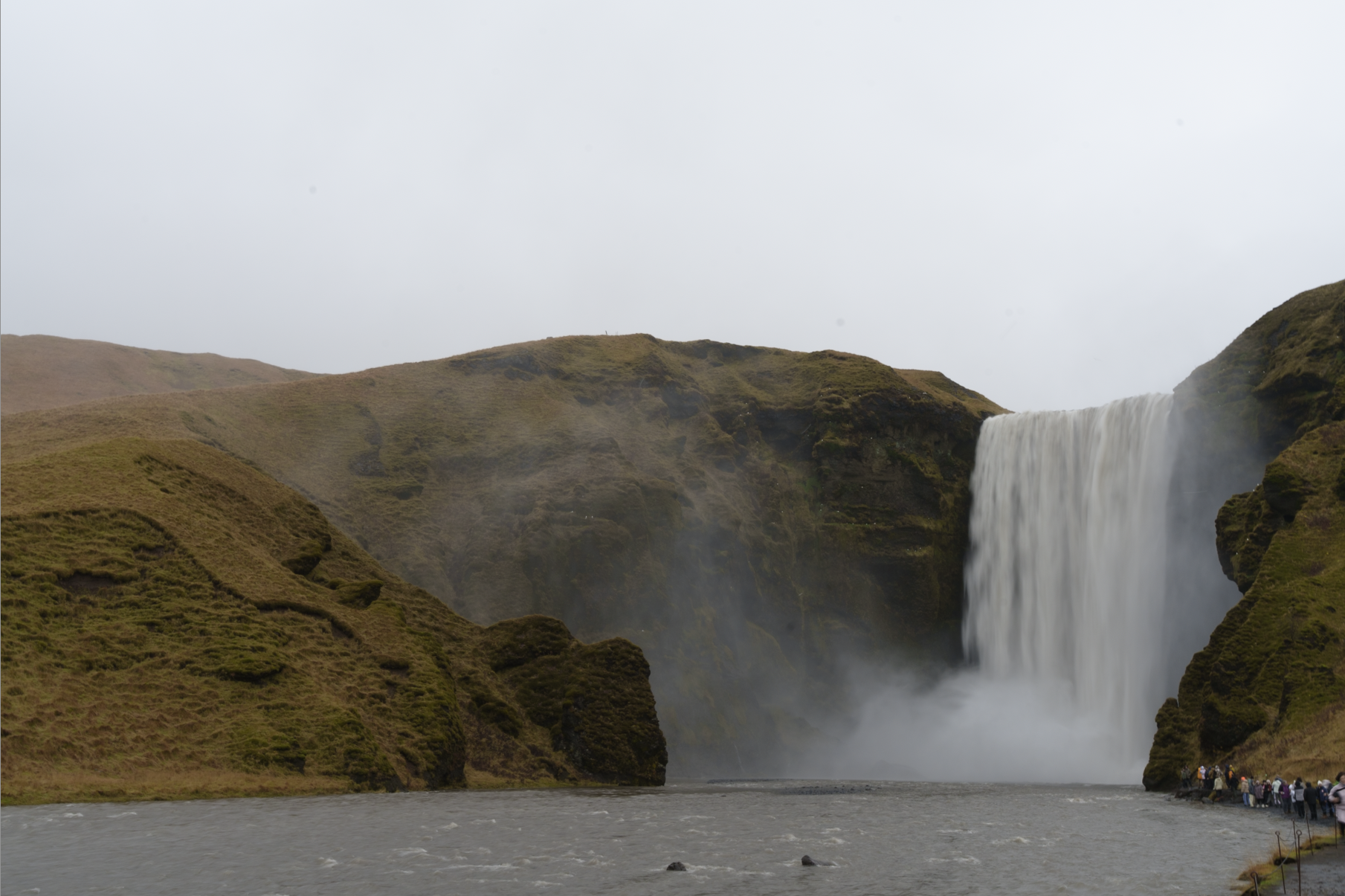
Initial capture and finished photograph. The brighter exposure recorded the water movement I was working toward; the finished treatment brings the scene closer to the atmosphere I remember.
The initial image shows the result. The pale sky occupies a large part of the frame. The hills are relatively bright, and the water sits close to the surrounding landscape in tone. Visitors line the edge of the river on the right. Looking at it, I can see both the scene and some of the constraints I was working within.
In the finished photograph, the cliffs have more weight. The falling water separates more clearly from the rock, and the cooler tones bring back something of the cold I remember. Mist spreads across the darker surfaces and gathers at the base of the falls. Those relationships carry much more of the atmosphere for me.
I wanted the edit to bring me closer to the experience of standing there. That meant making choices about how dark the cliffs should feel, how much attention the water should draw, and how the color held the scene together. The photograph became more deliberate as I worked toward the mood I remembered.
The view beside the waterfall mattered too. Across the outlet water, light was reaching the hills above a few small houses. Their position drew my attention: buildings sitting almost on the doorstep of the place I had traveled so far to photograph. The falls occupied most of my attention that morning, but this quieter view helped me see the surrounding landscape again.
In that photograph, the light on the slopes gives the eye somewhere to go beneath the heavy sky. The houses provide a scale I could understand. Together with the waterfall images, it brings back more of the place than the falling water alone.
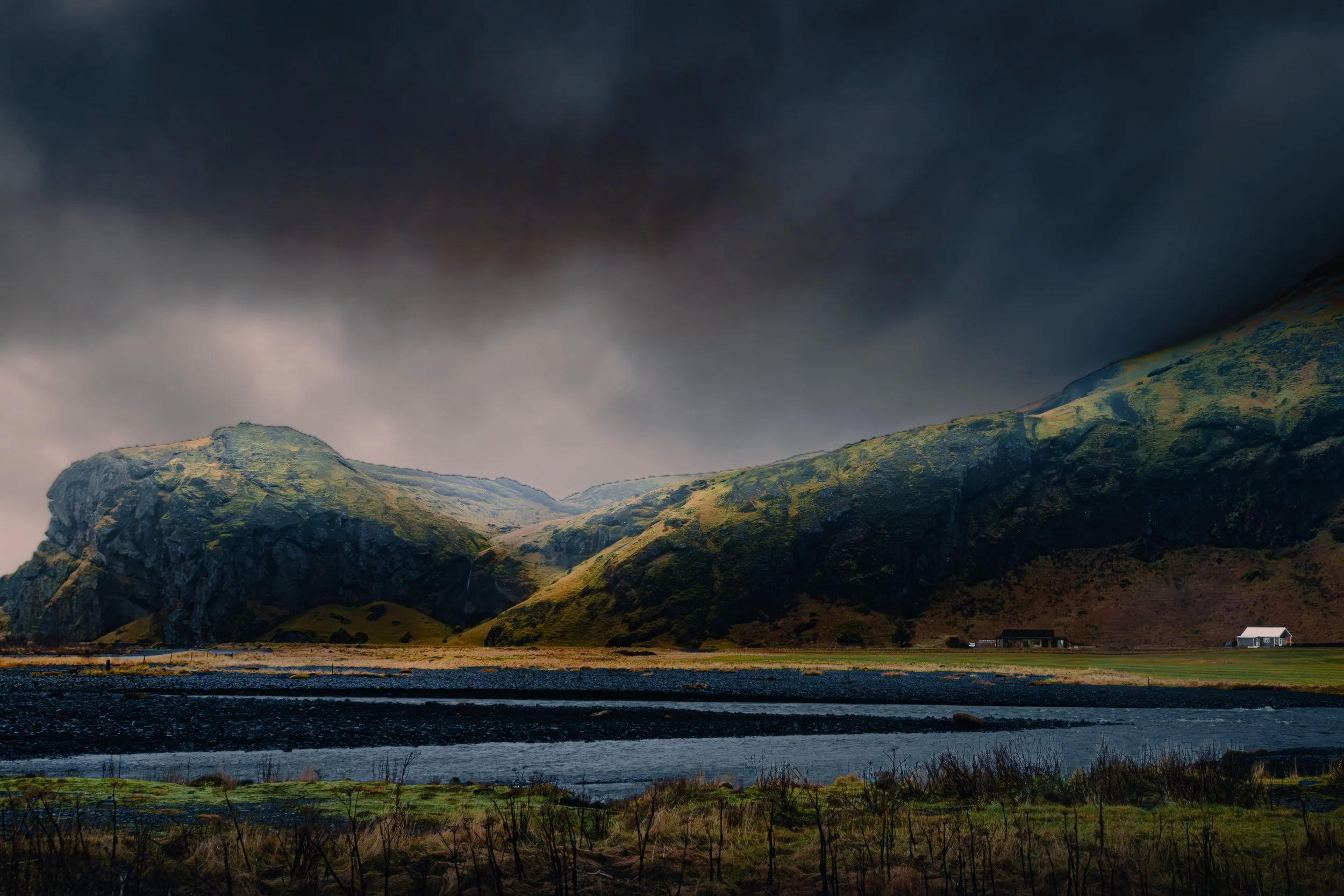
Beside Skógafoss, light reaches the hills above houses across the outlet water.
I didn’t leave Skógafoss certain I had captured what I wanted. I knew there might be another opportunity to stop on the way back toward Reykjavík. Later in the week, an approaching snowstorm gave that drive a different priority, and the return visit never happened.
By then, I had already changed a few things about how I worked. The clothing I needed came out of the suitcase before an excursion. Gloves became easier to find. On location, I slowed down and gave more attention to how I was recording a composition, making images with different settings so I had more than one interpretation of the light and movement to work with.
Skógafoss had made it clear, early in the trip, that I would need to adapt. The weather, light, and available space were all going to have a say in the photographs. I left humbled by that first attempt and excited to see what else the country had in store.
The finished image brings back the cold, the dark cliffs, and the movement of the water more closely than the initial capture does. It also brings back the uncertainty of leaving, with most of Iceland still ahead of me. Both belong to my memory of Skógafoss.